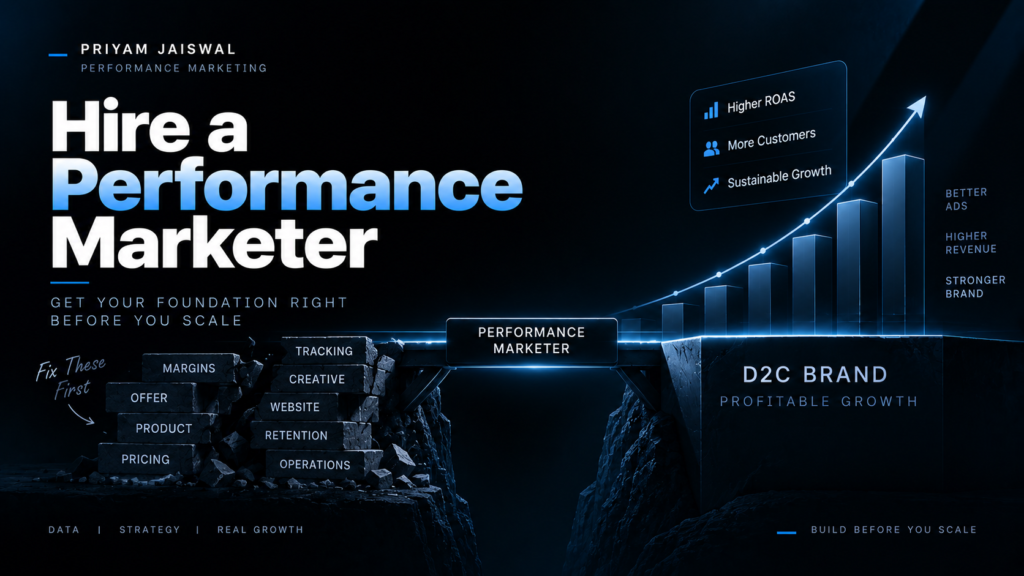
Quick Answer: Hire a performance marketer when you know your max allowable CAC, your tracking is trustworthy, your creative pipeline can feed the channel, you can fund a real learning budget, and you’ve confirmed acquisition is genuinely the bottleneck.
Hire before those things are true, and you’re not buying growth. You’re buying a more detailed explanation of why growth isn’t happening.
Working through this yourself? Start with the contribution margin math in section one. It takes an afternoon, and it will tell you more about your next hire than any interview.
Ecommerce customer acquisition cost is up roughly 40% since 2023. The average U.S. store now pays somewhere between $68 and $84 to acquire a customer, and Meta CPMs climbed about 20% year over year to land near $14. Google Search CPCs rose almost 13% in a year.
So the instinct is understandable: we need someone who actually knows Meta.
But here’s the pattern I see over and over with D2C founders. They hire a performance marketer to fix an acquisition problem, and six months later they’ve spent $60,000 on salary plus $300,000 on ads and the blended numbers look exactly the same. The marketer gets blamed. Sometimes fairly. Usually not.
The uncomfortable truth is that a performance marketer is a multiplier, not a generator. If your contribution margin is thin, your tracking is broken, and you produce four ad creatives a month, a great media buyer will simply help you lose money faster and with better dashboards.
This is the list of things worth sorting out before you post the job or sign the retainer.
1. Know your maximum allowable CAC before you interview anyone
Not your target CAC. Not what a competitor told you at a conference. The actual ceiling, derived from your own P&L.
Start with average order value, subtract COGS, subtract shipping and fulfillment, subtract payment processing, subtract your expected return rate. What’s left is first-order contribution margin. That number is the most you can pay to acquire a customer and break even on order one.
Then decide how much of a loss you’re willing to carry on the first order and how long you’ll wait to earn it back. Most healthy D2C brands aim for an LTV:CAC ratio of 3:1 to 4:1, with a payback period under 120 days. A ratio above 5:1 usually means you’re underspending and handing market share to someone braver.
Why this matters for hiring: if you can’t state your max allowable CAC in a single sentence, you cannot brief a performance marketer, evaluate one, or hold one accountable. You’ll end up arguing about ROAS screenshots instead of profit. Candidates worth hiring will ask you this question in the first interview. If you fumble it, the good ones walk.
2. Fix measurement before you fix media buying
Attribution loss from cookie deprecation and iOS privacy changes is now inflating reported CAC by an estimated 25% to 45%. Platform-reported ROAS and your actual bank account have not been on speaking terms for years.
Before a new hire touches a campaign, get these in place:
- Server-side conversion tracking (Conversions API for Meta, enhanced conversions for Google). This is table stakes now, not an optimization.
- A blended north-star metric. Marketing Efficiency Ratio — total revenue divided by total ad spend — is harder to game than platform ROAS and closer to how your business actually works.
- Post-purchase surveys. “How did you hear about us?” is imperfect and directionally more honest than most attribution models.
- Cohort reporting by acquisition month. Blended CAC hides unprofitable channels. Paid CAC now runs roughly 2.4x to 3.1x blended CAC in most categories, which means your “healthy” blended number may be carried entirely by organic and repeat purchases.
A performance marketer inheriting broken measurement will spend their first quarter rebuilding your data instead of scaling your revenue. That’s a fine use of a quarter — but decide deliberately that you’re paying for it.
3. Decide which role you’re actually hiring for
“Performance marketer” is three different jobs wearing one job title, and conflating them is the most common hiring mistake in D2C.
The media buyer lives inside Ads Manager. Structures accounts, manages bids and budgets, reads the auction, kills losers, scales winners. Tactical, fast, essential. Will not build your strategy.
The growth marketer owns the funnel end to end — paid acquisition plus landing pages, offers, retention loops, and the analytics that connect them. More expensive, more senior, more likely to tell you your product page is the actual problem.
The head of performance manages people and budget allocation across channels. You need this at roughly $500K/month in spend or when you have three-plus channels running. Not before.
Most sub-$5M D2C brands write a job description for a head of performance, pay for a media buyer, and get frustrated when nobody does strategy. Write the description for the job you actually need this quarter.
4. Run the real math on in-house vs. agency vs. freelancer
Founders compare a salary number to a retainer number, which is the wrong comparison. Here’s what the U.S. market actually looks like in 2026.
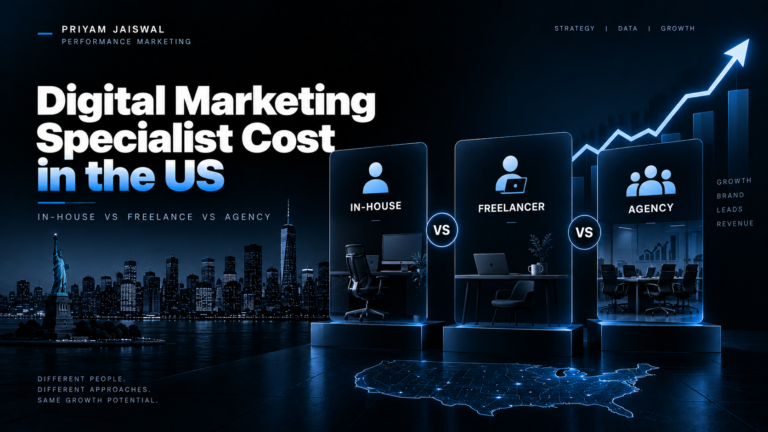
In-house. Performance marketing manager base salaries land roughly between $75,000 and $131,000 nationally, with Glassdoor putting the average near $108,000 and Robert Half’s guide showing New York ranging from about $102,000 to $179,000. Fully loaded — benefits, payroll tax, equipment, and a tool stack that easily runs $500 to $2,000 a month — you’re looking at 1.25x to 1.4x the base. Add three to six months of ramp before the hire is net positive.
Agency. Mid-market D2C retainers generally sit between $3,000 and $15,000 per month, with the $5,000 to $10,000 tier being the standard for brands doing $1M to $10M in annual revenue. Percentage-of-spend arrangements typically run 10% to 20% of media budget, often tapering as spend grows.
Freelancer. $2,000 to $6,000 per month for a strong solo media buyer, usually with a channel specialization and limited bandwidth.
The structural tradeoff matters more than the price. A flat retainer gives an agency no incentive to inflate your budget but no upside for efficiency either. Percentage-of-spend pays your agency more when they spend more, which is not always the same as earning you more profit. An in-house hire has your incentives but only one person’s worth of pattern recognition — an agency strategist has seen fifteen accounts in your category this year.
A practical rule: below roughly $50K/month in spend, an agency or freelancer usually wins on cost and breadth. Above $150K/month, in-house usually wins on focus and margin. In between, hybrids work — in-house owner, agency for channel depth.
5. Audit your creative supply chain first
This is the one founders skip, and it’s the one that kills hires.
On Meta, targeting is now largely the algorithm’s job. Creative is the actual lever a media buyer has left. Which means your performance marketer’s ceiling is set by how many distinct creative concepts you can put in front of them each month — and most brands can’t sustain the cadence. Ad fatigue on Meta typically calls for a creative refresh every two to three weeks.
Before you hire, answer honestly:
- How many new concepts (not resizes, not color variants) can you ship per month?
- Who writes the hooks? Who edits video? Are they in-house, freelance, or nonexistent?
- Do you have a UGC pipeline, or are you still using product photography from your launch?
- What’s your creative budget as a percentage of media spend? Under 10% is usually starving the channel.
If the answer is “we’ll figure it out,” you’re hiring a media buyer to sit in a Ferrari with no fuel. Either budget for creative alongside the hire, or hire someone who can produce it — and pay accordingly.
6. Set the scorecard before you make the offer
Write down what success looks like at 30, 60, and 90 days, and share it during the interview process. Something like:
- Day 30: Full account audit delivered. Tracking validated end to end. Baseline established for CAC, MER, and contribution margin by channel.
- Day 60: Restructured account live. A defined creative testing cadence running. First round of results read.
- Day 90: Paid CAC within X% of target at Y level of spend, or a written, evidenced case for why the target needs to move.
Note that last clause. A performance marketer who tells you in month three that your target CAC is unreachable at your current AOV is doing their job, not failing at it. Build room for that answer into the scorecard, or you’ll select for people who tell you what you want to hear and quietly buy branded search traffic to hit the number.
7. Ask the questions that separate operators from dashboard-readers
Skip “what’s your ROAS record.” Anyone can point at a good quarter. Try these instead:
- “Walk me through an account you scaled that then stopped working. What did you do?”
- “How do you decide whether a CAC increase is a media problem, a creative problem, or an offer problem?”
- “What’s your process when platform ROAS and blended MER disagree?”
- “Tell me about a time you told a founder to spend less.”
- “How would you spend the first $20,000 if you joined us tomorrow?”
The last one is the most revealing. Weak candidates describe campaign structures. Strong ones ask what your margin is, what your repeat rate looks like, and what you’ve already tested.
Ask for a paid audit or a paid trial project before a full-time offer or a twelve-month retainer. It’s the single most reliable signal of capability you can buy, and it costs a fraction of a bad hire.
8. Fund a real learning budget — or wait
Paid media needs statistically meaningful volume before optimization means anything. Hiring a performance marketer and handing them $5,000 a month to work with produces noise, not learning. The account never exits the learning phase, every result is within the margin of error, and by month four you conclude the hire didn’t work.
Rough guidance: if you can’t commit to at least three months of spend at a level that generates roughly 50 conversions per week per campaign, you’re not ready for a dedicated hire. Use a freelancer, keep the budget disciplined, and revisit at higher volume.
Also worth planning for: Q4 typically brings 35% to 50% higher CPCs as holiday competition spikes, while Q1 tends to be the most efficient window. Hiring in October and judging performance on November numbers is a way to fire a good marketer for the calendar’s sins.
9. Be honest about whether acquisition is even your bottleneck
The last question, and the most valuable one. If your repeat purchase rate is weak, your email and SMS flows are half-built, your product page converts at 1.2%, or your AOV can’t support your category’s CPMs, then paid acquisition isn’t your constraint — it’s just where the constraint becomes visible.
Email and SMS carry the lowest marginal CAC of any channel once the list exists. A conversion rate improvement from 1.8% to 2.4% has exactly the same effect on CAC as a 25% drop in CPM, and you control the first one entirely.
Sometimes the highest-leverage hire isn’t a performance marketer at all. It’s a CRO specialist, a retention lead, or a better creative partner. The founders who scale profitably are usually the ones who diagnosed that correctly before spending on a hire.