Ask three agencies to quote you on the same Amazon account and you’ll get three numbers that look nothing alike. One says $2,500 a month. One says 15% of spend. One says a small base fee plus a cut of the revenue they generate. Same account, same catalog, same goals. Wildly different bills.
That spread isn’t a pricing accident. It’s the model, and the model decides what your agency gets paid to care about. That’s the part most pricing pages skip.
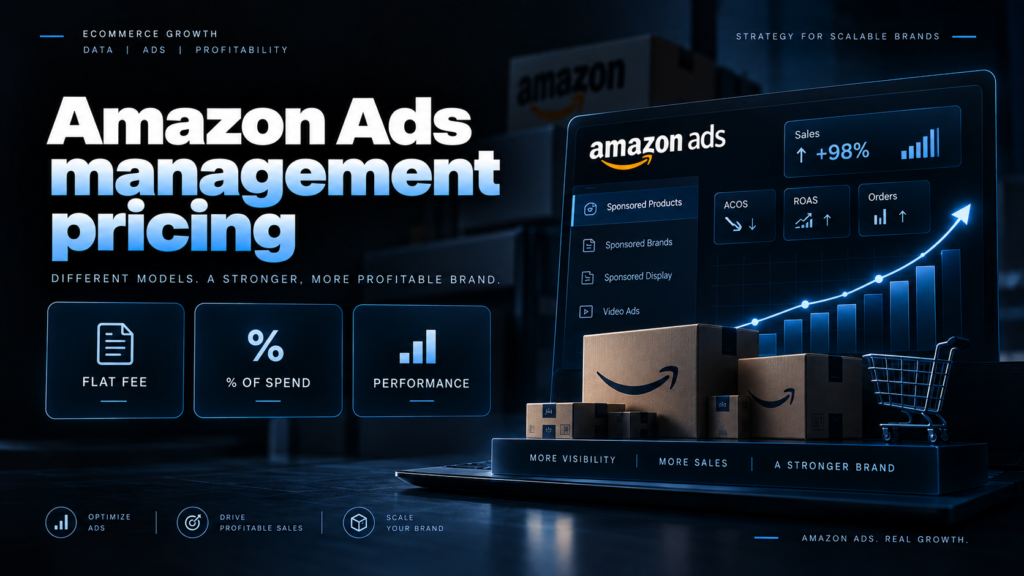
Quick answer: most Amazon Ads management runs $1,500 to $5,000 a month as a flat retainer, or 10% to 20% of ad spend with a $1,000 to $2,500 monthly floor. Performance and hybrid deals usually pair a $1,000 to $2,000 base with 2% to 5% of ad-attributed revenue above an agreed baseline. For the majority of sellers, a flat fee is the safest structure, because it’s the only one where nobody profits from your budget getting bigger.
Here’s how each model actually behaves once real money runs through it.
First, the thing that trips everyone up
Your management fee and your ad budget are two separate expenses.
If an agency quotes $3,000 a month and you’re spending $20,000 on ads, your total outlay is $23,000. The $20,000 goes straight to Amazon. The $3,000 buys you the person deciding where that budget lands.
Sounds obvious. It still causes arguments every single onboarding, usually around week three when the first invoice shows up next to the Amazon billing statement.
Worth knowing what you’re buying, too. Full-service Amazon Ads management typically covers campaign builds, bid and budget management, search term mining, negative keyword work, creative for Sponsored Brands, and reporting. Listing optimization, catalog work, A+ content, and DSP are often priced separately. Setup or onboarding fees of $500 to $2,500 are common and worth asking about before you sign anything, not after.
Model 1: Percentage of ad spend
The most common structure in the market, and the one with the most obvious flaw.
How it works: you pay 10% to 20% of whatever you spend on Amazon Ads that month. Almost every agency attaches a minimum, usually $1,000 to $2,500, so tiny accounts still cover their own cost of service.
What it costs in practice: at $20,000 a month in ad spend, a 15% fee is $3,000. Nothing alarming there.
Now scale. Push that same account to $50,000 a month and the fee becomes $7,500. The work didn’t get two and a half times harder. The account didn’t get two and a half times more complicated. The invoice just followed the budget, because that’s the only thing it’s tied to.
Who it genuinely suits: sellers with seasonal or unpredictable budgets. If you spend heavily in Q4 and go quiet in February, a percentage fee breathes with you instead of draining a slow month. Agencies also like it because revenue tracks growth, which is fair enough.
The catch nobody says out loud: your agency earns more when you spend more, full stop. Not when you profit more. Not when your ACoS improves. When you spend.
Most of the time that tension stays theoretical, because most agencies are decent and want to keep clients. But it shows up in the small moments. Should we pull back on that campaign, the one with a weak conversion rate and thin inventory? Under a percentage model, recommending a budget cut means the agency voluntarily reduces its own paycheck. That’s a lot to ask of anyone, every month, forever.
If you use this model, ask for the fee to be capped above a spend threshold. Good agencies will say yes.
Model 2: Flat monthly retainer
You pay the same number every month regardless of what happens in the ad account.
What it costs in 2026, by brand size:
| Your Amazon revenue | Typical flat retainer |
|---|---|
| Under $500K/year | $500 to $2,000 (freelancer or boutique) |
| $500K to $2M/year | $3,000 to $5,000 |
| $2M to $10M/year | $5,000 to $10,000 |
| $10M+/year | $10,000 to $15,000+ |
Enterprise accounts with hundreds of SKUs, multiple marketplaces, and DSP running alongside can land anywhere from $12,000 to $25,000 and up.
Why it’s gained ground: flat pricing has become noticeably more popular, and it’s not a mystery why. It pays for efficiency instead of volume. The agency’s incentive is to keep you happy enough to renew, and the fastest route to that is making your existing budget work harder.
Budgeting is easier, too. You know your marketing cost twelve months out. If you’re running Amazon Ads for business planning that depends on predictable overhead, that alone is worth a lot.
The catch: a flat fee can quietly go stale. If you signed at $3,000 when you had 20 SKUs and you now have 90 across three marketplaces, you’re getting less attention per product than you were. Scope creep runs in both directions. Build in a scope review every six months so the price reflects the actual work.
Also watch for flat fees that are flat because the service is thin. A cheap retainer that buys you automated bid rules and a monthly PDF isn’t management. It’s a subscription to a spreadsheet.
Model 3: Performance-based and hybrid
The model everyone says they want, and almost nobody structures properly.
How it’s supposed to work: a reduced base fee, usually $1,000 to $2,000, plus a performance component. That component is commonly 2% to 5% of ad-attributed revenue above an agreed baseline, or a bonus tied to a specific target like a TACoS threshold or a profit number.
Why it’s appealing: incentives finally line up. Your agency makes more when you make more. If they underperform, they eat part of it. On paper, it’s the cleanest deal in the room.
Why it’s rarer than the marketing suggests: most arrangements labelled performance-based are a flat fee with a bonus clause attached. That’s not the same thing. A real hybrid has downside for the agency, not just upside.
There’s also a measurement problem. Amazon attribution is genuinely messy. If your bonus is tied to ad-attributed revenue, you’re both arguing about a number that Amazon’s reporting decides, and neither of you controls it. Someone launches a killer TikTok, sales spike, the agency’s bonus goes up. Someone stocks out for nine days, sales tank, the agency loses money on work they did correctly.
Who it suits: established accounts with stable inventory, a clean baseline from at least six months of history, and both sides willing to agree in writing what counts as incremental. If you can’t define the baseline in one sentence, you’re not ready for this model.
The comparison, side by side
| Percentage of spend | Flat retainer | Performance / hybrid | |
|---|---|---|---|
| Typical cost | 10% to 20% of spend, $1K to $2.5K minimum | $1,500 to $15,000/month | $1K to $2K base + 2% to 5% of incremental revenue |
| Cost predictability | Low | High | Medium |
| Agency earns more when | You spend more | You renew | You earn more |
| Best for | Seasonal or volatile budgets | Most sellers, stable spend | Mature accounts with clean baselines |
| Main risk | Budget inflation | Stale scope as you grow | Attribution disputes |
So which one should you actually pick?
Flat fee. For most sellers, most of the time.
Not because percentage pricing is a scam, and not because performance deals are bad in theory. Flat wins because it’s the only model where your agency’s revenue doesn’t move when your budget does. That removes the one conversation you never want to have: wondering whether a recommendation to scale is strategy or self-interest.
This matters more in 2026 than it did three years ago. Amazon CPCs climbed from around $0.89 in 2023 to roughly $1.21 by early 2026, a jump of about 35% in three years. More than 70% of sellers now advertise, compared to roughly 40% five years back. Average ACoS sits somewhere near 32% to 34%. Traffic costs more and margin is tighter, which means the job has shifted from buying volume to protecting efficiency. A fee that rewards volume is fighting the actual work.
Two exceptions worth naming honestly. If your spend swings hard by season, percentage pricing genuinely protects your cash flow in slow months, so take it and negotiate a cap. And if your account is mature, your inventory is reliable, and you’ve got a clean twelve-month baseline, a properly structured hybrid is the best deal available to you. Just make sure it has teeth on both sides.
Five questions to ask before you sign
- What’s the total monthly cost at my current spend, and at double it? Make them do the arithmetic in front of you.
- Is onboarding included, or billed separately? Setup fees of $500 to $2,500 are normal. Surprise setup fees are not.
- Who’s actually on my account daily, and how many other accounts do they carry? A senior name on the pitch call and a junior on the login is the oldest trick in the business.
- What happens if we agree to reduce spend? Watch the face. The answer tells you more than the contract does.
- What’s the notice period? Month-to-month or 30 days is reasonable in 2026. Twelve-month lock-ins with no performance out are not.
FAQ
How much does Amazon Ads management cost per month?
Most sellers pay between $1,500 and $5,000 a month. Freelancers typically charge $500 to $2,000, boutique agencies $1,500 to $5,000, full-service agencies $5,000 to $15,000, and enterprise support $12,000 to $25,000 or more. Percentage-based pricing usually runs 10% to 20% of ad spend with a $1,000 to $2,500 minimum. Your ad budget is paid separately to Amazon.
Is a flat fee or percentage of ad spend better for Amazon Ads?
A flat fee is better for most sellers because the agency has no financial reason to push your budget higher. Percentage pricing suits businesses with seasonal or unpredictable spend, since the fee shrinks in slow months. If you go percentage, negotiate a cap above a set spend level.
Should I pay an Amazon Ads agency based on performance?
Only if your account has stable inventory and at least six months of clean history to set a baseline. Performance deals typically look like a $1,000 to $2,000 base plus 2% to 5% of ad-attributed revenue above that baseline. They fail when the baseline is vague or when Amazon’s attribution muddies who earned what.
When is my business big enough to hire an Amazon Ads agency?
The rough threshold is $5,000 or more in monthly ad spend, or around $50,000 in monthly Amazon sales. Below that, a freelancer or in-house time usually makes better economic sense. The fee has to be small enough relative to your margin that the improvement can outrun the cost.
Does the management fee include my ad budget?
No. Management fees and ad spend are separate. A $3,000 retainer on a $20,000 monthly budget means $23,000 total, with the $20,000 going directly to Amazon.
Not sure which model fits your account?
Most of this comes down to two things: how predictable your spend is, and how much margin you have to give away. Both are specific to your catalog, and neither is answerable from a blog post.
If you want a straight read on what you should be paying and whether your current setup is quietly working against you, book a 20-minute call. No deck, no pitch sequence. Bring your spend number and your ACoS and we’ll talk through it.