Full disclosure before we start: I’m a freelancer. So yes, I have a horse in this race. 🐎
But I’ve also seen plenty of US businesses sign long agency contracts, pay a healthy fee every month, and then quietly wonder who is actually running their ads. I’ve inherited a few of those accounts. Some were in decent shape. Others had campaigns nobody had touched in weeks.
So this isn’t a “freelancers good, agencies bad” post. It’s the honest math on what you get from performance marketing companies versus a solo specialist, when each one makes sense, and how to tell the difference before you sign anything.
The Short Answer
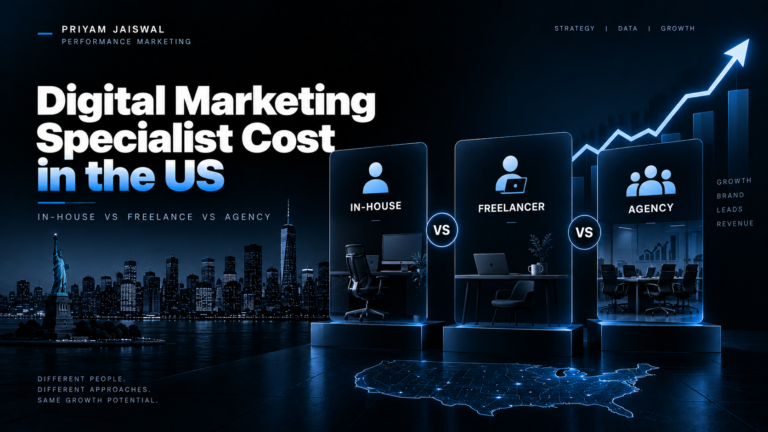
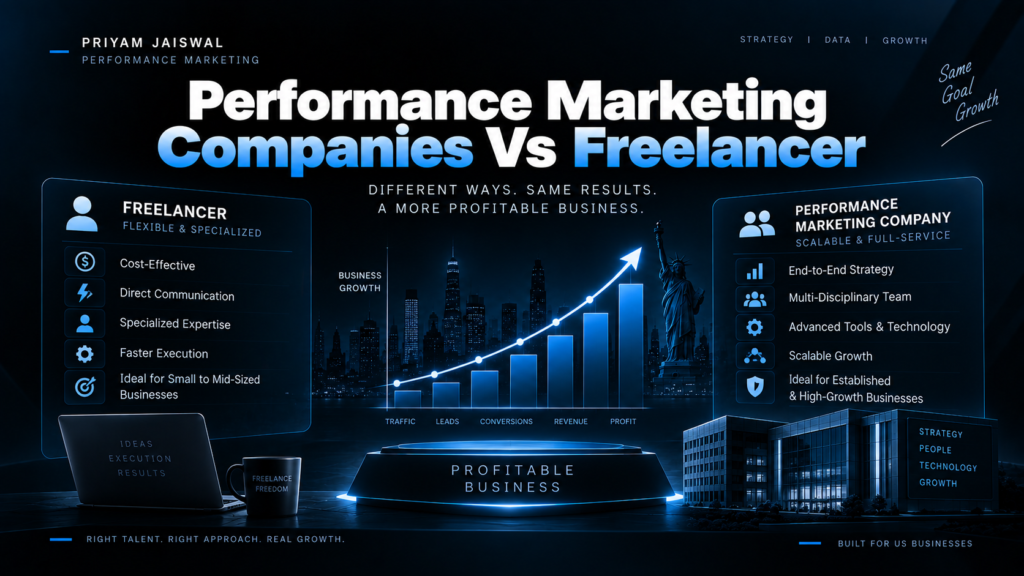
Performance marketing companies are the better fit when you spend $50K or more a month on ads, need several channels coordinated at once, or require formal contracts, SLAs, and backup staff. A freelance performance marketer usually delivers more senior attention per dollar for businesses spending roughly $2K to $30K a month, especially on one to three channels like Google Ads and Meta Ads.
That’s the TL;DR. The rest of this post covers the why, plus the questions that’ll save you from a bad hire in either direction.
What Performance Marketing Companies Actually Sell You
A performance marketing company (you’ll also see “performance marketing agency”) runs paid campaigns built around measurable outcomes: leads, sales, app installs, booked calls. Think Google Ads, Meta Ads, TikTok, Amazon, and programmatic, plus the creative and landing pages that feed them.
On paper, you’re hiring a team. In practice, the lineup usually looks like this:
- The person who sold you. Often a senior strategist or partner. Great on the call. You may not hear from them again until renewal.
- An account manager. Your day-to-day contact who handles updates, reports, and calendar invites.
- A media buyer or specialist. The person actually inside your ad accounts. Sometimes senior, often mid-level or junior.
- The supporting cast. Designers, copywriters, and analysts, depending on your package.
None of this is shady. It’s just how agencies scale. According to agency consultant Karl Sakas, an account manager who isn’t doing the hands-on work typically handles 4 to 8 accounts, while a strategist might juggle 8 to 12. Media buyers commonly carry 5 to 8 accounts before quality starts slipping.
Here’s the catch. Your account is one of several on that person’s plate, and the person on your kickoff call might not be the one adjusting your bids at 4 p.m. on a Tuesday.
How US Performance Marketing Companies Price Their Services in 2026
Most agencies use one of three pricing models, or a blend.
| Pricing model | How it works | Typical 2026 range | Watch out for |
|---|---|---|---|
| Flat monthly retainer | Fixed fee for management, strategy, and reporting | About $1,500 to $10,000+ per month; growth agencies often $6,000 to $25,000 | Paying the same amount in slow months |
| Percentage of ad spend | The agency takes a cut of your media budget | Usually 10% to 20%; some charge 15% to 30% | Fees climb as you scale, even when the workload doesn’t |
| Hybrid or performance-based | Base retainer plus bonuses tied to results | Varies widely | Fuzzy definitions of what counts as a “conversion” |
Two things most proposals won’t spell out for you.
The fee doesn’t include your ad spend. A $6,000 retainer covers zero dollars of actual Google or Meta media. You budget for both, separately.
The ratio matters more than the number. One 2026 agency pricing guide makes a sharp point: paying $15K a month to manage $30K in ad spend means half your media investment is going to fees, and that only pays off if your ROAS doubles. A healthier benchmark is management fees landing somewhere around 10% to 20% of spend.
For smaller accounts, fair market ranges look more like $1,000 to $2,000 a month for Google Ads management on $5K to $15K of monthly spend, and $1,500 to $3,500 a month for paid social on $5K to $25K.
Contracts have gotten friendlier too. The common setup in 2026 is a 90-day initial commitment followed by 30-day cancellation terms. If someone slides a 12-month lock-in across the table with no performance clause, that’s your cue to start asking questions.
What You Get With a Freelance Performance Marketer
A freelancer is one specialist who plans, builds, runs, and reports on your campaigns directly. No handoffs. The person you talk to is the person inside your ad account.
Freelance rates are all over the map. On Upwork, entry-level Google Ads specialists typically charge $15 to $40 an hour, mid-level specialists $40 to $85, and senior consultants $85 to $175 or more. Plenty of experienced freelancers skip hourly billing entirely and work on monthly retainers, which commonly fall between $500 and $3,000 a month.
What that money usually buys:
- Senior hands on your account. You aren’t funding layers of management, so more of your fee goes to actual work.
- Faster decisions. Want to pause a campaign or test a new offer? That’s one message, not a ticket sitting in somebody’s queue.
- Direct accountability. When results dip, there’s nobody else to point at. (Speaking from experience, that’s very motivating.)
- Flexibility. Most freelancers are open to shorter commitments, project-based audits, or scoped trial periods.
What it doesn’t buy:
- A backup bench. Freelancers get sick and take vacations. A good one plans for it, but there aren’t five people waiting in the wings.
- Everything under one roof. If you need paid media, SEO, email, video production, and a website rebuild all at once, one person can’t do all of it well. Anyone who says otherwise is selling something.
- Enterprise paperwork. Some procurement teams need vendor SLAs, insurance certificates, and a legal entity with its own finance department.
Performance Marketing Companies vs. Freelancers: Side by Side
| Factor | Performance marketing company | Freelance performance marketer |
|---|---|---|
| Who does the work | A team, often mid-level or junior media buyers | The specialist you hired |
| Who you talk to | An account manager | The person running your ads |
| Typical cost | $1,500 to $25,000+ monthly retainer, or 10% to 20%+ of ad spend | Hourly ($15 to $175+) or a monthly retainer |
| Speed of changes | Hours to days, depending on process | Often same day |
| Channel coverage | Broad: paid media, SEO, creative, CRO | Usually 1 to 3 channels, done in depth |
| Redundancy | Built in | Limited; depends on the person |
| Best-fit ad spend | $50K+ per month | Roughly $2K to $30K per month |
| Contract style | Often a 90-day minimum | Usually more flexible |
When a Performance Marketing Company Is the Smarter Buy
I’d genuinely tell someone to hire an agency in these situations:
- You’re spending $50K+ a month across a lot of channels. At that scale, you need people covering Google, Meta, TikTok, Amazon, and creative testing simultaneously. One person turns into the bottleneck.
- You need creative at volume. Meta and TikTok chew through ad creative fast. If you need dozens of fresh variations every month, an agency with in-house designers and video editors has a real edge.
- Your company needs vendor structure. Procurement, compliance, legal review, SLAs. Some businesses simply can’t hire an individual contractor for this kind of work.
- You want one partner accountable for SEO, paid, email, and web. Full-service agencies tend to hold on to clients longer, and there’s a reason. Focus Digital’s 2026 churn report found full-service shops have the lowest client churn, around 25% a year, largely because everything’s connected and switching is painful.
If that sounds like you, go agency. Just vet them properly using the questions further down.
When a Freelancer Wins
Flip the situation around, and a freelancer is usually the better deal when:
- Your ad spend sits between $2K and $30K a month. At this level, agency retainers can eat a painful share of your budget, and there’s a good chance you’d end up on a junior buyer’s roster anyway.
- You’re focused on one to three channels. Most small and mid-sized US businesses get the bulk of their paid revenue from Google Ads and Meta Ads. You need depth there, not a buffet.
- You’ve been burned by an agency before. This comes up constantly. The same Focus Digital report puts PPC agencies at the highest client churn of any agency type, roughly 49% a year. And when clients do leave, lack of communication is the most commonly cited reason.
- You want to talk to the person doing the work. No relay race. No “let me check with the team and circle back.”
- Speed matters. Launching a promo on Friday? A freelancer can usually turn changes around faster than an agency’s weekly sprint cycle allows.
The Hidden Costs Nobody Puts in the Proposal
The monthly fee is the part you see. These are the parts you don’t.
The learning curve. Any new partner, agency or freelancer, needs time to learn your account, your audience, and your margins. The first 90 days are where a lot of engagements quietly fall apart. Switch partners every six months and you’ll pay that tax over and over.
Tracking debt. If your conversion tracking is broken, nobody can optimize well, no matter how talented they are. Ask whether a tracking audit (GA4, Meta Pixel and Conversions API, Google Ads conversions) is included or billed on top.
Reporting fluff. Some monthly reports are 40 slides of impressions and click-through rates. Very pretty. Mostly useless. What you actually need is revenue, cost per acquisition, ROAS, and a plain-English summary of what changed and why.
Account ownership. Make sure your ad accounts are created under your business, not your agency’s. If you part ways, you should walk out with your data, your pixel history, and your campaigns. This applies to freelancers too, by the way.
Creative add-ons. Plenty of retainers cover “management” but bill separately for new ads. On Meta especially, that can quietly double what you really pay each month.
8 Questions to Ask Before You Hire Either One
Whether you’re talking to one of the big performance marketing companies or a solo specialist, these questions separate the pros from the pitch decks:
- Who will actually be inside my ad accounts every week? Get a name, not a department.
- How many other accounts does that person handle?
- How will you define and track a conversion for my business? If they jump straight to campaign types without asking about tracking, targets, and margins, consider that a red flag.
- What’s the minimum commitment, and what does leaving look like?
- Who owns the ad accounts, pixels, and data? The only correct answer is “you do.”
- Can you show results from a business with a similar model and budget? Crushing it for a DTC skincare brand doesn’t automatically translate to B2B lead gen.
- What does a normal week of optimization look like? Vague answers here usually mean not much happens in a normal week.
- What happens when you’re out sick or on vacation? A fair question for freelancers. Honestly, a fair question for agencies too, since account manager turnover is very real.
Why I Chose to Work Independently
I’m Priyam Jaiswal, a performance marketer working with businesses in the US, UK, and India across e-commerce, edtech, healthcare, real estate, and app marketing.
Across my client work, I’ve managed over $400K in annual ad spend that’s driven more than $1M in client revenue, at a blended ROAS of 3.65x. Most of that runs through Meta Ads, Google Ads, and app marketing channels.
I stayed independent on purpose. When you work with me, you don’t get passed to a junior buyer after the kickoff call. I build the campaigns, I watch the numbers, and I’m the one explaining what happened when a week goes sideways. That’s the whole model.
I’m also upfront about the limits. If you need a 15-person team producing creative across six channels, I’ll tell you on the first call, and I’ll probably point you toward a few agencies worth talking to. A good referral beats a bad fit every time.
So, Which One Should You Pick?
Here’s the simple version:
- Big budget, lots of channels, need structure? Go with one of the established performance marketing companies.
- Growing business, focused channels, want senior attention? Hire a proven freelancer.
- Still not sure? Start with an audit. Whoever you hire should be able to tell you exactly what’s working, what’s leaking money, and what they’d fix first.
Either way, don’t hire based on the logo wall or the lowest quote. Hire the person or team that asks sharper questions about your business than you expected.
Want a second opinion on your ad account? I offer a free performance audit for US businesses running Google Ads or Meta Ads. You’ll get a clear breakdown of where your budget is going and what I’d change first. No 40-slide deck, promise. Book your free ad account audit
Frequently Asked Questions
What do performance marketing companies do?
Performance marketing companies plan and manage paid advertising campaigns that are measured by specific results, such as leads, sales, or app installs. Most manage channels like Google Ads, Meta Ads, TikTok, and Amazon, and many also handle ad creative, landing pages, and conversion tracking.
How much do performance marketing companies charge in the US?
In 2026, most US performance marketing companies charge either a flat monthly retainer, commonly $1,500 to $10,000+ for small and mid-sized accounts, or a percentage of ad spend, usually 10% to 20%. Larger growth agencies often charge $6,000 to $25,000 a month. Ad spend is always billed separately from the fee.
Is it cheaper to hire a freelancer than a performance marketing agency?
Usually, yes. Freelance Google Ads and Meta Ads specialists typically charge less than agency retainers, and more of the fee goes to hands-on work instead of account management layers. The tradeoff is less redundancy and narrower channel coverage.
When should a business hire an agency instead of a freelancer?
Hire an agency when you spend more than about $50K a month on ads, need multiple channels and creative production handled together, or require formal vendor contracts and service-level agreements.
How do I know if my performance marketing agency is doing a good job?
Look at business outcomes, not activity. You should get clear reporting on revenue, cost per acquisition, and ROAS, know exactly who works on your account, and receive specific explanations of what changed each month. If you can’t get those answers, an independent audit is a smart next step.