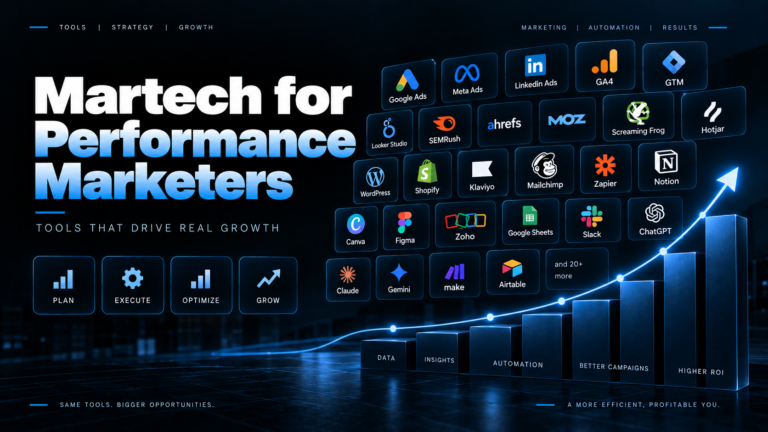
Quick answer: You need one tool per job, not fifteen. For tracking, Google Tag Manager and GA4 (free) plus server-side tagging once you’re past ₹5L/month in spend. For reporting, Looker Studio (free) with Windsor.ai (from ~$19/mo, about ₹1,800) or Supermetrics (from $39/mo, about ₹3,700) as the pipe. For creative research, the Meta Ad Library (free) before you pay for Foreplay ($49–59/mo, about ₹4,600–5,500). For Amazon, Helium 10 (Platinum ~$99/mo annual, about ₹9,300). For attribution, stay on free tools until you’re spending enough that a 10% measurement error costs more than the subscription. Most brands under ₹3L/month of ad spend need nothing beyond the free tier.
A founder showed me his stack last month. Eleven subscriptions. Around ₹80,000 a month, before anyone had run a single ad.
I asked him one question: what’s your break-even ROAS?
He didn’t know. Eleven tools, and not one of them had told him the only number that decides whether his advertising makes money or loses it.
That’s the trap. Tool lists are written by affiliates who get paid per signup, so every list has forty tools and every tool is “essential.” Here’s a different approach: one pick per job, what it costs, and — the part nobody writes — when you should not buy it yet.
Prices are as of September 2026, converted at roughly ₹94.5 to the dollar. SaaS pricing moves constantly, so check the vendor’s page before you put in a card. I’ve watched three of these tools change their pricing this year alone.
The rule I use before buying anything
A tool earns its subscription when the decision it improves is worth more than the fee.
Sounds obvious. Almost nobody applies it.
If you’re spending ₹1L a month and a tool costs ₹15,000, it needs to improve your results by 15% just to break even. Can it? Sometimes. But a ₹15,000 attribution tool that tells you Meta is over-reporting by 20% is worthless if you weren’t going to reallocate budget anyway.
Buy the tool when you’re ready to act on what it tells you. Not before.
Tracking and measurement: get this right or nothing else matters
Free pick: Google Tag Manager + GA4 + Meta Pixel with Conversions API
Nothing you buy later fixes broken tracking. I’ve audited accounts where the client was paying for a ₹20,000/month attribution tool sitting on top of a pixel that was firing purchase events twice. They weren’t measuring their business. They were measuring a bug, expensively.
GTM and GA4 cost nothing and handle 90% of what most brands need. Meta’s Conversions API is free too, and if you’re running Meta ads without it in 2026, you’re throwing away signal.
When to upgrade: past roughly ₹5L/month in spend, server-side tagging (Stape, from around $10/mo) starts paying for itself in recovered conversion signal. Below that, browser-side done properly is fine.
What I’d skip: paid tag management. GTM is free and better.
Attribution: the most oversold category in marketing
Paid pick: Triple Whale (free plan available; paid from around $149/mo, roughly ₹14,000, scaling with your GMV)
I’ll be blunt about this category. Attribution tools are sold on anxiety — the fear that Meta is lying to you. Meta is over-reporting. But knowing by how much only helps if you’ll actually shift budget because of it.
Triple Whale’s free plan gives you blended analytics and last-click attribution, which is genuinely useful. The paid tiers add multi-touch attribution through their own pixel. Worth noting: their pricing is reported inconsistently across the web — I found four different starting figures while researching this. That tells you something about how often it changes. Check their page directly.
When to buy: when you’re running three or more channels at meaningful spend and genuinely cannot tell which one is working. Not before.
When to skip: single-channel brands. If Meta is 90% of your spend, Meta’s own reporting plus your Shopify numbers will tell you what you need. Spend the ₹14,000 on creative instead.
Reporting: where agencies quietly lose their weekends
Free pick: Looker Studio Paid pick: Windsor.ai (from ~$19/mo, about ₹1,800) or Supermetrics (from ~$39/mo, about ₹3,700)
Looker Studio is free and connects to Google’s own products without help. The moment you need Meta, Amazon or LinkedIn data in the same dashboard, you need a connector.
Windsor is the cheaper structure: one axis of pricing (data sources), unlimited users, destinations included. Supermetrics charges across three axes at once — sources, destinations and seats — so a ₹3,700 sticker price can become ₹30,000 fast once your team grows and you’re sending the same data to both Looker Studio and Sheets. It’s also been maintaining these connectors for over a decade, and when Meta changes an API without warning, that track record has real value.
Full disclosure: Windsor is what I run. Cheaper structure, and it handles the client volume I need. Your mileage will differ.
When to skip both: if you’re running one or two channels, export a CSV. Seriously. A connector that saves you twenty minutes a month is a subscription you’re buying for the feeling of being organised.
Creative: the actual lever
Free pick: Meta Ad Library Paid picks: Foreplay (~$49–59/mo, about ₹4,600–5,500) for research, Motion (from ~$250/mo, about ₹23,500) for analytics
Creative is where campaigns are won now. Targeting has been largely automated away by Advantage+ and Performance Max. What’s left in your control is the ad itself.
The Meta Ad Library is free, and most people underuse it badly. You can see every ad your competitors are running right now, including how long each has been live — the longest-running ads are usually the winners, because nobody keeps spending on a loser.
Foreplay and Motion do different jobs, and people confuse them constantly. Foreplay is before you launch: saving inspiration, organising swipe files, briefing creators. Motion is after: connecting hooks, formats and angles to actual performance.
Motion’s entry price is steep for most Indian brands. At ₹23,500/month it needs to make your creative meaningfully better, which requires you to already run structured creative tests with consistent naming. Without that discipline, you’re paying for a prettier dashboard.
When to buy Foreplay: when your swipe file is a chaotic screenshots folder and you’re briefing creators weekly. When to buy Motion: when you’re testing 10+ creatives a month and losing track of which concept won.
Amazon: the one category where the tool is non-negotiable
Pick: Helium 10 (Platinum ~$99/mo annual or ~$129 monthly, roughly ₹9,300–12,100)
Amazon is the exception to everything above. You cannot do keyword research on Amazon manually. There’s no free equivalent to Cerebro for reverse-ASIN lookups, and flying blind on Amazon PPC costs far more than the subscription.
Two things to know before you sign up. The old $39 Starter plan was retired for new users in early 2026, so Platinum is now the entry point. And Adtomic, their PPC automation tool, isn’t included at Platinum — it’s a Diamond feature or a ~$199/month add-on.
Honestly? Skip Adtomic at first. Manual bid management on a catalog under 50 SKUs beats automation you don’t understand yet. On the electronics catalog I run, most of the ACOS improvement from 35% to 24% came from restructuring campaigns and killing keywords, not from automation.
What I’d actually buy at three spend levels
| Monthly ad spend | Stack | Approx. monthly cost |
|---|---|---|
| Under ₹2L | GTM + GA4 + Meta CAPI + Meta Ad Library + Looker Studio + a spreadsheet | ₹0 |
| ₹2L–₹10L | Add a connector (Windsor/Supermetrics) + Foreplay + Helium 10 if you’re on Amazon | ₹6,000–₹17,000 |
| ₹10L+ | Add server-side tagging, attribution, and Motion if creative volume justifies it | ₹40,000–₹60,000 |
If you’re in row one and spending more than zero, something’s gone wrong.
The tool nobody sells you
A spreadsheet with your break-even ROAS in it.
You need three numbers: product margin, average order value, and target profit. That gives you the threshold below which every rupee of ad spend is destroying value. No tool on this page will tell you that number, because it comes from your P&L, not your ad account.
That founder with eleven subscriptions? We cancelled six, worked out his break-even ROAS at 2.1x, and discovered two campaigns had been running at 1.4x for four months. The spreadsheet found what ₹80,000 of software missed.
FAQ
What are the best performance marketing tools for beginners? Google Tag Manager, GA4, Meta Pixel with Conversions API, the Meta Ad Library, and Looker Studio. All free. Together they handle tracking, competitor research and reporting for most brands under ₹3L/month in ad spend.
How much should I spend on marketing tools? As a rough guide, keep tooling under 5% of your ad spend. At ₹2L/month that’s ₹10,000 — enough for a connector and a creative research tool, not enough for a full attribution suite.
Do I need an attribution tool like Triple Whale? Only if you’re running three or more channels at meaningful spend and will actually reallocate budget based on what it tells you. Single-channel brands get most of the value from platform reporting plus their store analytics.
Is Helium 10 worth it for Amazon PPC? Yes, if you’re selling on Amazon seriously. There’s no free substitute for reverse-ASIN keyword research. Start on Platinum and skip the Adtomic add-on until your catalog outgrows manual bid management.
What’s the difference between Foreplay and Motion? Foreplay is pre-launch: research, swipe files, creative briefs. Motion is post-launch: which hooks and formats actually drove results. They solve opposite ends of the creative cycle and aren’t substitutes.
Which free performance marketing tools are actually good? GA4, Google Tag Manager, Meta Ad Library, Looker Studio, Microsoft Clarity for session recordings, and Google Search Console. That set covers tracking, research, reporting and CRO at zero cost.
Before you buy anything else
Work out your break-even ROAS. Then look at your campaigns. If any are running below it, no tool on this list will save you — and the fix costs nothing.
If you want a second pair of eyes on what your account is actually doing, I do free 15-minute teardowns. No pitch, and I’ll tell you if you don’t need me.