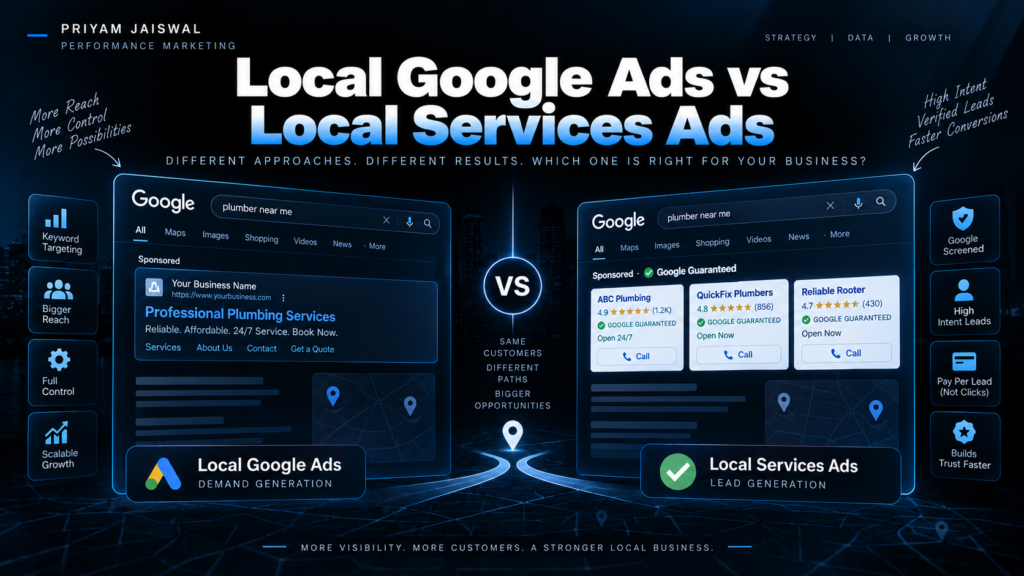
Short answer: If your business falls into one of Google’s approved service categories and you can pass the background check, run local service ads first. You pay per lead instead of per click, and the Google Guaranteed badge does a lot of quiet persuading before anyone picks up the phone. If you’re outside those categories, or you sell something that needs explaining before someone commits, Google local ads (regular Search and Maps campaigns) are your play. Most businesses with real budget end up running both, and that’s usually the right call.
Now the longer version, because the details are where budgets get wasted.
First, let’s clear up the naming mess
Google has never been great at naming things, and this corner of the ad platform is a good example.
Google local ads is the umbrella term most people use for any paid placement that shows up when someone searches with local intent. Think Search ads triggered by “plumber near me,” ads that appear inside Google Maps, and Performance Max campaigns pointed at store visits or local leads. You pay per click. You control the keywords, the copy, the landing page, and the geography.
Local service ads, officially Local Services Ads or LSAs, are a different animal entirely. They sit above everything else on the page, above the regular ads and above the map pack. They show your star rating, your review count, and either a Google Guaranteed or Google Screened badge. There are no keywords, no ad copy, and no landing page. You pay when someone calls, messages, or books through the ad.
Same search results page. Completely different machinery underneath.
The 2026 change nobody prepared for
Here’s the part that makes most comparison articles out of date.
In August 2026, Google started folding Local Services Ads into the main Google Ads platform. They’re becoming a specialized Performance Max campaign type built for pay-per-lead goals, with bidding, reporting, and management changes rolling out from August 2026 onward. The first phase covered selected home and storefront service advertisers in the United States, with non-US accounts scheduled for 2027.
What stays the same: the ads still appear only on Google Search and Google Maps, in the same positions, and you still pay per valid lead rather than per click.
What changes, and this is the annoying part: manual bidding goes away, per-service targets collapse into one combined Target CPA, and historical performance data does not transfer. The standalone Local Services Ads dashboard redirects into Google Ads once your account migrates.
If you’re running LSAs right now, export your reports before the migration email lands. You get about two weeks of notice, and once the data’s gone, it’s gone. [Google Ads Help documentation on the Local Services Ads transition to Performance Max]
Does this change the LSA vs Google local ads decision? Not really. It changes where you click, not what you’re buying. The economics stay put.
How the money actually works
This is the real fork in the road, so let’s put numbers on it.
| Local service ads | Google local ads | |
|---|---|---|
| You pay for | Valid calls, messages, bookings | Clicks |
| Typical cost | About $53 per lead average in home services, roughly $25 to $150 by trade | $8.33 average CPC in home improvement, around $30 to $80 per lead |
| Who can run it | Approved categories only, after verification | Almost anyone |
| Setup time | Days to weeks (background checks, license and insurance proof) | Same afternoon |
| Message control | None, Google builds the listing | Total control |
| Ranking factors | Reviews, response speed, proximity, budget | Bids, Quality Score, relevance |
| Bad leads | Disputable for credit | You ate the click |
SearchLight Digital’s February 2026 benchmark tracked $6.72 million in LSA spend across 888 contractors and 126,650 leads, landing on a $53 average cost per lead for home services. Ranges swing hard by trade, from roughly $10 to $40 for lawn care in smaller markets up to $50 to $150 for water damage restoration in metros.
On the Google Ads side, WordStream’s 2026 benchmarks put the priciest verticals at legal services ($9.87), home improvement ($8.33), and dental ($8.00) per click. Cost per lead generally lands between $30 and $80 for home services and anywhere from $50 to $200 or more for legal.
Notice that the cost per lead numbers aren’t wildly far apart. The difference isn’t price. It’s risk. With local service ads, a bad month means fewer leads. With Google local ads, a bad month means you bought 400 clicks from people comparing prices, reading your blog, or clicking by accident.
The eligibility wall
Before you fall in love with pay-per-lead, check whether Google will even let you in.
LSAs are category-gated. Approved categories include plumbing, HVAC, electrical, locksmith, garage door, appliance repair, cleaning, lawn care, pest control, real estate agents, lawyers, and financial planners, among others. If you run a restaurant, a retail store, an ecommerce brand, a B2B service, or anything Google hasn’t approved, LSAs simply aren’t available to you. Even in approved categories, coverage thins out in smaller cities and rural markets.
Verification isn’t a formality either. The Google Guaranteed badge requires background checks, proof of licensing and insurance, and a minimum review rating. Budget a couple of weeks for it, and don’t plan a launch around a date you can’t control.
So for a huge chunk of local businesses, this whole debate resolves itself in about ninety seconds. No approved category, no decision to make. Google local ads it is.
When local service ads win
You sell urgency. Burst pipe. No AC in August. Locked out at midnight. Those searchers aren’t comparison shopping, they’re calling whoever appears first with a badge and decent stars. LSAs own that real estate.
You have a strong review profile. Reviews are a direct ranking input for LSAs, which means good reviews lower your effective cost, not just your conversion rate. If you’re sitting on 4.8 stars and 200 reviews, you’re leaving money on the table by not running them.
You answer the phone fast. Response time affects ranking. If calls go to voicemail during business hours, LSAs will punish you for it, and you’ll blame the channel instead of the front desk.
You’re small and cash-sensitive. Paying only when someone contacts you is a genuinely friendlier model when you can’t afford a learning period.
When Google local ads win
You’re not eligible. Covered above. Moving on.
Your service needs explaining. Anyone selling a considered purchase (cosmetic dentistry, solar, legal specialties, high-ticket remodels) needs a landing page, proof, pricing context, and a form. LSAs give you a phone number and a prayer.
You want to control who calls. Keywords, match types, negatives, audience signals, ad schedules, and geo-targeting are all levers LSAs don’t give you. If you only serve three ZIP codes or you refuse to take rental property jobs, Google local ads let you say so.
You care about the data. Search terms, landing page behavior, assisted conversions, offline conversion imports. LSAs report leads and little else.
You want to build something durable. Retargeting pools, first-party audience lists, and landing pages that also serve your organic traffic. LSAs build Google’s asset, not yours.
The honest answer: run both, in the right order
Here’s the sequence that works for most eligible local businesses.
Start with local service ads. Cheaper entry, faster proof, less that can go wrong. Give it 60 to 90 days and track cost per booked job, not cost per lead. A $55 lead that books at 45% is a $122 customer acquisition cost. A $30 lead that books at 12% is a $250 customer. The cheaper lead lost.
Once LSAs are producing consistently and you’ve capped out on lead volume (and you will, since LSA volume is limited by local demand and how many leads Google can send you), layer Google local ads underneath. Target the searches LSAs can’t reach: specific services, brand terms, competitor comparisons, higher-intent long-tail queries.
Rough starting split for an eligible service business: 60 to 70% into LSAs, the rest into Search. Adjust based on which one produces cheaper booked jobs, and be prepared for that answer to flip seasonally.
Whatever you do, dispute your bad LSA leads. Wrong number, wrong service area, spam calls, all creditable. Businesses that never file disputes are quietly paying 10 to 15% more than they need to.
FAQ
What is the difference between Google local ads and local service ads?
Google local ads are pay-per-click campaigns on Search and Maps where you control keywords, ad copy, and landing pages. Local service ads are pay-per-lead listings that appear above all other results with a Google Guaranteed or Google Screened badge, where Google builds the listing and you pay only when someone calls, messages, or books.
Are Local Services Ads going away in 2026?
No. They’re moving into the Google Ads interface as a Performance Max campaign type with pay-per-lead goals. The placements and billing model stay the same. The separate dashboard, manual bidding, and per-service targets are what’s disappearing.
How much do local service ads cost in 2026?
Average cost per lead in home services sits around $53, with typical ranges from $25 to $150 depending on trade and market. Lawn care and cleaning sit at the low end. Water damage restoration and roofing sit at the top.
Can I run both at the same time?
Yes, and most businesses with budget above roughly $2,000 a month should. They occupy different positions on the same page, so you’re not bidding against yourself in any meaningful way.
Do local service ads work without good reviews?
Poorly. Review count and rating feed directly into LSA ranking, so a thin review profile means less visibility at a higher effective cost. Fix the reviews first, then turn on the ads.
Where to start
Check your eligibility today. If you qualify, start the verification process this week, because the background check is the slow part and there’s no way to rush it. If you don’t qualify, build a proper Search campaign with tight geo-targeting and a landing page that actually converts.
And whichever direction you go, track cost per booked job. Everything else is vanity.
Need someone to run the math on your account before you commit budget? Get in touch with us for a free look at your current local campaigns.