Quick answer: In 2026, the average cost to advertise on Google is $5.42 per click and $66.69 per lead across all industries in the US. Most businesses spend between $1,000 and $10,000 per month on ad budget, plus $500 to $5,000 per month if someone else manages the account. Your actual cost depends on your industry far more than on anything you do inside Google Ads. Legal services average $9.87 per click. Arts and entertainment average $1.63.
Ask ten agencies what it costs to advertise on Google and you’ll get ten different answers, most of them starting with “well, it depends.” Technically true. Completely useless when you’re trying to decide whether to put $3,000 a month behind this thing.
So let’s do it differently. Below are the actual 2026 numbers, where they come from, and the math you can run on the back of a napkin to figure out what your number should be. I’ve spent the last six years managing paid search budgets across US, UK, and Indian accounts, and the single biggest cost mistake I see isn’t overbidding. It’s people budgeting from industry averages instead of their own unit economics. More on that near the end.
What does it actually cost to advertise on Google in 2026?
Here are the four numbers that matter, pulled from WordStream and LocaliQ’s 2026 Search Advertising Benchmarks report, which analyzed 13,474 US search campaigns across 23 industries between April 2025 and March 2026:
| Metric | 2026 average |
|---|---|
| Cost per click (CPC) | $5.42 |
| Click-through rate (CTR) | 6.64% |
| Conversion rate (CVR) | 8.18% |
| Cost per lead (CPL) | $66.69 |
Two things about that table are more interesting than they look.
First, $5.42 per click is more than double the $2.32 average recorded when these benchmarks started back in 2016. Clicks have gotten steadily more expensive for a decade and nothing about 2026 suggests that reverses.
Second, and this is the genuinely good news: cost per lead actually dropped in 2026, down from $70.11 the previous year. It’s the first decrease in five years. Conversion rates improved in 87% of industries, which means the cheaper leads came from better closing, not cheaper clicks. Advertisers got better at turning traffic into action.
That’s the headline. Now let’s break it into the pieces you can actually plan around.
Why is my cost per click different from the average?
Because Google doesn’t sell clicks at a fixed price. It runs an auction every single time somebody searches, and the price you pay is set by five things:
Competition in your vertical. If four other roofers in your zip code want the same search, the price goes up. Simple as that.
Your Quality Score. Google scores your keyword relevance, expected click-through rate, and landing page experience. A high-quality ad can outrank a higher bid and pay less per click for the privilege. This is the one lever that’s genuinely in your control.
Geography. A “personal injury lawyer” click in Manhattan and the same click in Boise are not remotely the same purchase.
Device and time of day. Mobile clicks are often cheaper and often worse. Weekday business hours cost more in B2B.
Seasonality. Roofing spikes after storms. Tax services spike in March. Retail spikes in Q4 and takes your CPC with it.
One trend worth watching: Focus Digital’s analysis of $1.2 billion in Google Ads spend found Q2 2026 averaging 3.3% monthly CPC growth, which they attribute partly to AI Overviews cutting organic click-through and pushing more businesses into paid placements. When organic traffic dries up, everyone crowds into the auction. That crowding is a cost you pay for.
What does it cost to advertise on Google in my industry?
This is where averages start earning their keep. Here’s the 2026 spread across major US verticals:
| Industry | Avg. CPC | Avg. CPL |
|---|---|---|
| Attorneys and legal services | $9.87 | $131.63 |
| Home and home improvement | $8.33 | $90.92 |
| Dentists and dental services | $8.00 | Varies by procedure |
| Health and fitness | Above average | Above average |
| All industries | $5.42 | $66.69 |
| Travel | Under $3.00 | Below average |
| Restaurants and food | $2.05 | Below average |
| Arts and entertainment | $1.63 | Below average |
A $9.87 click in legal isn’t a crisis and a $1.63 click in entertainment isn’t a win. Both are normal. The pattern has held for a decade: industries with the highest customer lifetime value pay the most per click, because they can. A law firm that closes one case worth $15,000 can absorb a lot of expensive clicks. A pizza place cannot.
The year-over-year movement tells its own story. Real estate CPCs jumped 27.3%, personal services and health and fitness both rose 23.4%. Education dropped 22.8% and beauty dropped 18.9%. The categories getting more expensive are largely the ones where AI Overviews are eating informational search traffic, forcing businesses to buy back the visibility they used to get free.
If your vertical is on the rising side of that list, budget for costs to keep climbing rather than holding flat.
How much should I budget per month to advertise on Google?
Forget the average for a second. Budget from capacity, not from what other people spend.
The formula is simple:
Monthly budget = (jobs or sales you can actually handle ÷ your lead-to-sale rate) × your target cost per lead
Here’s what that looks like in practice.
Worked example: a local HVAC company
Say you can take on 25 extra installs a month. Leads don’t book at 100%. The 2026 Local Services Ads benchmark from SearchLight Digital puts the average booking rate across trades at 43.9%, so call it 44%.
- 25 jobs ÷ 0.44 = roughly 57 leads needed
- At an HVAC cost per lead near $51, that’s about $2,900 per month
That’s a defensible number. You can walk into a meeting with it. “We spend $2,900 because that’s what 25 installs costs” beats “we spend $3,000 because that felt right.”
Worked example: an ecommerce store
Ecommerce works backwards from margin instead of capacity. Triple Whale’s 2026 data puts the average Google Ads order value at $87.65 with an average ROAS of 3.27.
If your gross margin is 40%, your break-even ROAS is 1 ÷ 0.40 = 2.5x. Anything above that is profit. Anything below it is you buying revenue at a loss and calling it growth.
So the budget question becomes: how much can I spend while staying above 2.5x? Start small, find the ceiling, scale to it.
[break_even_roas_calculator]
Worked example: B2B lead generation
At the $66.69 all-industry CPL, a 20% lead-to-customer close rate puts your cost per acquired customer at about $333. If a customer is worth $5,000 in contract value at 60% gross margin, you’re netting $3,000 to acquire at $333. That’s a nine-to-one return and you should be spending more, not agonizing over CPC.
Notice that in all three examples, the industry average was an input, never the answer.
What is the minimum budget to advertise on Google?
Google has no minimum. You can set a daily budget of $5 and run. Whether that’s worth doing is a different question. Here’s roughly what each tier buys you in 2026:
Under $1,000 per month. Enough for one tightly focused campaign on high-intent, bottom-funnel keywords in a single service area. At a $5.42 average CPC you’re buying around 180 clicks. Don’t split this across campaign types. Pick the searches closest to a purchase and own them. Expect the data to come in slowly, because 180 clicks a month takes a while to reach statistical significance.
$1,000 to $3,000 per month. The realistic floor for a local service business that wants consistent lead flow. You can run a branded campaign, a core non-branded campaign, and get enough conversion volume for Smart Bidding to have something to learn from. Most automated bidding strategies need roughly 30 conversions in 30 days before they stop guessing.
$3,000 to $10,000 per month. Now you can segment properly. Separate campaigns by service line, geography, or margin. Run Performance Max alongside Search. Test landing pages with enough traffic that the test means something.
$10,000 and up. Full-funnel. Search, Shopping or Performance Max, YouTube, Demand Gen, remarketing, incrementality testing. At this level the management quality matters more than the budget size.
One caution on the low end. A budget too small to produce 30 conversions a month will underperform not because Google Ads doesn’t work, but because you’ve given the automation nothing to optimize toward. If you can’t reach that threshold on your main conversion action, track a softer one (calls, form starts, qualified page views) and optimize to that instead.
What does it cost to have someone else run my Google Ads?
Your ad spend goes to Google. The management fee goes to whoever runs the account. Two separate costs, and plenty of agencies quote them as one number to make the total look smaller.
Current 2026 market rates in the US:
| Model | Typical range | Best suited to |
|---|---|---|
| Percentage of ad spend | 10% to 20% of monthly spend, usually with a minimum | Budgets over $10,000/mo |
| Flat monthly retainer | $500 to $5,000+ | Stable budgets under $10,000/mo |
| Hourly | $100 to $149/hr (Clutch, 2026) | Audits, one-off fixes, consulting |
| Hybrid | Base fee plus a smaller percentage | Growing accounts |
Freelance specialists generally run $500 to $2,500 per month. Small and mid-size agencies land around $1,500 to $5,000. Complex or multi-location accounts go from $5,000 to $10,000 and up.
Two things to check before you sign anything.
The minimum fee is the real price at low spend. An agency advertising “10% of ad spend” with a $1,500 monthly minimum is charging you 30% if you’re spending $5,000. Ask for the minimum in writing.
Ask what’s included versus billed separately. Landing pages, conversion tracking setup, server-side tagging, creative production, and feed management are often quoted as extras after you’ve signed. The loaded cost of an engagement frequently runs well above the headline management fee once those land on the invoice.
And the honest version of the value question: management fees make sense when the person managing the account can find more value than they cost. On a $2,000 monthly budget, a $750 fee needs to improve results by more than 37% just to break even. On a $20,000 budget, the same fee needs a 3.75% improvement. The math gets friendlier as the budget grows, which is exactly why small accounts are so often better served by a good one-time setup plus a quarterly audit than by an ongoing retainer.
Are Local Services Ads cheaper than Google Ads?
For US home service businesses, usually yes, and it isn’t close.
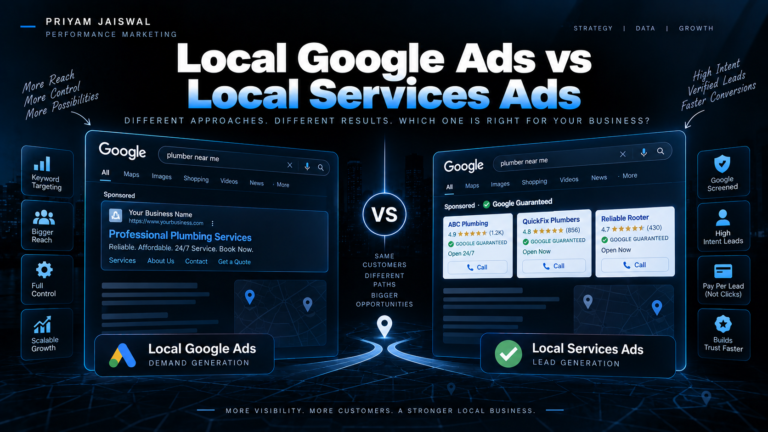
Local Services Ads sit above everything else on Search and Maps, carry the Google Guaranteed badge, and charge per valid lead instead of per click. SearchLight Digital’s February 2026 benchmark tracked $6.72 million in LSA spend across 888 contractors and 126,650 leads. The results:
- Blended cost per lead: $53
- Booking rate: 43.9%
- Cost per paying customer: $233
- Average ticket: $1,826
- Closed return on ad spend: 7.84x
By trade: electrical $39, HVAC $51, plumbing $57, drain and sewer $59, roofing anywhere from $71 to $162 depending on market.
Compared against the same firm’s Google Ads dataset, LSA leads came in 49% cheaper than blended Google Ads leads ($53 versus $104) and 64% cheaper than non-branded search leads ($149). Booking rates were higher too: 43.9% against 37.6% for non-branded search.
The catch is that LSA ranking isn’t a pure auction. Google weighs your review count, star rating, answer rate, and how quickly you respond to bookings. You can’t outbid a competitor who answers the phone faster than you do. Missing calls will tank your placement no matter what you’re willing to pay.
For professional services, legal LSA leads run roughly $50 to $150 depending on practice area, with dental and med spa typically between $30 and $80. Those categories use Google Screened rather than Google Guaranteed, and the lower trust signal makes conversion rates swing more.
Most contractors should run both. LSA for volume at the cheapest cost per lead, Search for the higher-ticket and more specific queries LSA categories don’t cover.
What changed in 2026 that affects what I pay?
Three structural shifts, all worth knowing before you set a budget.
AI Max is now the default for Search. Since August 3, 2026, you can no longer create new campaign-level broad match or legacy automatically created assets campaigns. Starting September 2026, existing ones auto-upgrade to AI Max. Dynamic Search Ads follow in February 2027, with Google sending in-account notices from September 2026 and reminders on January 15, 2027. AI Max adds keywordless matching, text customization, and final URL expansion to standard Search campaigns. The practical cost impact is that your ads will reach queries you never explicitly targeted. That can lower your cost per acquisition or quietly inflate it, depending on how disciplined your negative keyword list and conversion tracking are. Audit both before the migration hits your account.
Standalone Display campaigns are gone. They’re being retired into Demand Gen, with migration running into 2027. Display inventory now sits alongside YouTube, Discover, Gmail, and Maps inside Demand Gen. If you were using cheap Display traffic to pad your click numbers, that era is over.
Ads are moving inside AI answers. Google Marketing Live 2026 confirmed ads appearing in AI Mode and AI Overviews, currently in testing with US advertisers running English-language queries. Eligible campaign types are Performance Max, AI Max with search term matching, Shopping, and broad match campaigns. Nobody has reliable cost data on these placements yet. What we do know is that eligibility depends on the boring stuff: accurate landing pages, complete feeds, deep asset libraries, and clean conversion signals. Same work that pays off everywhere else.
How do I know if I’m paying too much to advertise on Google?
Here’s the part most cost articles skip. The benchmarks above tell you what other people pay. They tell you nothing about whether you are overpaying, because that’s a question about your margins, not the market’s.
Run these two numbers instead.
Your maximum viable cost per lead: Gross profit per sale × lead-to-sale close rate = the most you can pay for a lead and still break even.
A contractor with $1,826 average tickets at 45% margin makes $822 gross profit per job. At a 44% booking rate, the maximum viable CPL is $822 × 0.44 = $362. Against a $53 LSA lead, that business has enormous headroom and should be spending far more aggressively than it probably is.
Your break-even ROAS: 1 ÷ gross margin percentage.
At 40% margin, that’s 2.5x. At 25% margin, it’s 4x. At 60% margin, it’s 1.67x. Every ROAS conversation you have should start with this number, because a 3x ROAS is excellent for one business and bankruptcy for another.
If you’re above your break-even threshold, your Google Ads costs are fine even if your CPC is triple the industry average. If you’re below it, cutting your CPC won’t save you. Fix the offer, the landing page, or the close rate first.
I’ve audited accounts paying $12 a click that were wildly profitable and accounts paying $1.80 that were bleeding money. The click price was never the story.
FAQ
How much does it cost to advertise on Google per month?
Most US small businesses spend between $1,000 and $10,000 per month on Google Ads. Local service businesses commonly land between $1,500 and $5,000, while ecommerce and B2B accounts scale higher. Budget from your capacity and margin rather than from an average, using the formula: (sales you can handle ÷ close rate) × target cost per lead.
What is the average cost per click on Google Ads in 2026?
The average cost per click across all industries is $5.42, according to WordStream and LocaliQ’s 2026 benchmark report covering 13,474 US search campaigns. Attorneys and legal services pay the most at $9.87, while arts and entertainment pay the least at $1.63.
Is there a minimum budget to advertise on Google?
No. Google Ads has no minimum spend requirement and you can start with a daily budget of a few dollars. In practice, most automated bidding strategies need around 30 conversions in 30 days to perform well, so budget to reach that threshold on your main conversion action or optimize toward a softer one until you can.
How much do agencies charge to manage Google Ads?
US agencies typically charge 10% to 20% of monthly ad spend, or a flat retainer of $500 to $5,000 per month. Freelance specialists generally run $500 to $2,500 monthly. Always ask for the minimum fee in writing, since a percentage-based quote with a high floor can work out to a much higher effective rate on small budgets.
Are Google Ads still worth it in 2026?
For businesses with clear unit economics, yes. Cost per lead dropped for the first time in five years in 2026, down to $66.69 from $70.11, and conversion rates improved in 87% of industries. The deciding factor isn’t the market rate, it’s whether your gross profit per sale supports your cost per acquisition.
Do I pay Google when someone sees my ad or only when they click?
On Search campaigns you pay per click, so impressions are free. Local Services Ads charge per valid lead (a call, message, or booking) rather than per click. Display and video campaigns can be billed on impressions or views depending on the bidding strategy you choose.
How much does it cost to advertise on Google Maps?
Google Maps placements are served through Local Services Ads and Performance Max. LSAs averaged $53 per valid lead across US home services trades in February 2026, ranging from $39 for electrical work to $162 for roofing in competitive markets.
What to do with these numbers
Pick the two that apply to you: your industry’s average cost per lead, and your own maximum viable cost per lead. If the second number is comfortably bigger than the first, you have a spending opportunity, not a cost problem. If it’s smaller, no amount of bid tuning fixes that. The offer or the margin has to change first.
Run your own numbers through the calculator above before you set a budget. And if you want a second opinion on an account that’s spending money without a clear answer on whether it’s working, that’s most of what I do.