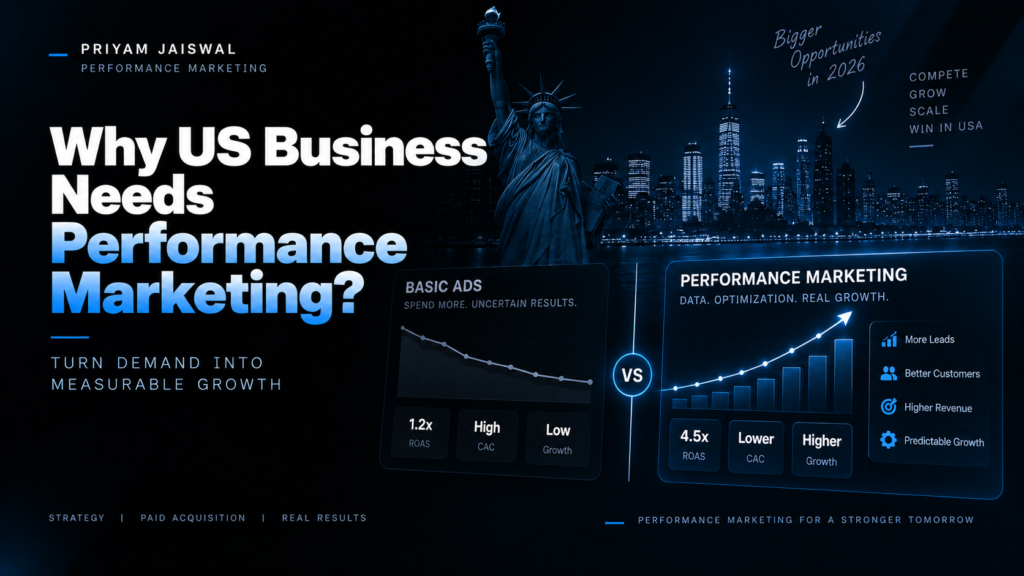
Performance marketing is advertising you pay for based on outcomes: leads, phone calls, booked jobs. Not impressions. Not “brand lift.” Not a monthly PDF full of graphs going up and to the right while your phone stays quiet.
For a US service business in 2026, it matters for one blunt reason. The channels that used to be simple enough to run yourself stopped being simple this year. Google is dismantling the Local Services Ads dashboard. Roughly two-thirds of Google searches now end without a click. And nearly half of American consumers ask an AI chatbot for a local recommendation before they ever open a browser tab.
You can keep spending the way you did in 2023. It’ll just cost you more to get less.
“I already run ads. Isn’t that the same thing?”
No, and this is where most owners get stuck.
Running ads means money leaves your bank account and something happens. Performance marketing means you know which dollar produced which booked job, and you can turn the good ones up.
Here’s the difference in practice. When I open a new account for a plumber, an HVAC company, or a med spa, the same three things are broken almost every time:
- Conversion tracking is either missing or lying. Form fills counted twice. Phone calls not tracked at all. Someone once had “page view” set as their primary conversion, which means Google spent eleven months optimizing for people who visited and left.
- Nobody knows their break-even cost per lead. They know what a lead “feels” expensive. That’s not a number you can bid against.
- The budget is split evenly across campaigns because that felt fair, rather than weighted toward the two campaigns actually producing paying customers.
Fix those three and you usually don’t need more budget. You need the same budget pointed somewhere useful.
The numbers your competitors already have
Cost per lead is meaningless in isolation, but you still need a reference point. Here’s what 2026 data says for US service businesses.
Google’s Local Services Ads averaged $53 per lead across home services in February 2026, based on SearchLight’s benchmark tracking $6.72M in spend across 888 contractors. Standard Google Ads search runs considerably higher: the WordStream/LocaliQ 2026 dataset puts the all-industry average cost per lead at $66.69, with home and home improvement at $90.92 and legal at $131.63. Meta tends to land lower for home services, around $34 average with most trades in a $30–$50 band, though roofing can push past $115.
Now the part almost nobody calculates. That same SearchLight data shows an average book rate of 43.9%, a cost per paying customer of $233, and an average ticket of $1,826. Do the math and the closed ROAS across that dataset is 7.84x.
So a $53 lead isn’t cheap or expensive. It’s cheap if your team answers the phone and your average job is worth $1,800. It’s a disaster if you’re closing 12% and your ticket is $300.
That’s the whole job, really. A performance marketer works backwards from what a customer is worth to you, sets a maximum you can pay to acquire one, and then keeps the ads inside that number. Everything else is decoration.
Google just moved your goalposts (and gave you two weeks’ notice)
This is the most concrete reason to pay attention right now.
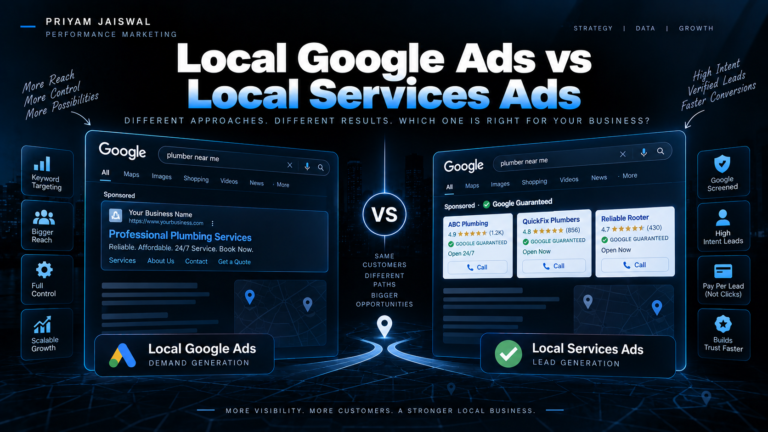
Google is folding Local Services Ads into the main Google Ads platform as a specialized Performance Max campaign type built for pay-per-lead goals. The first phase started in August 2026 for select US home and storefront advertisers, covering plumbing, HVAC, electrical, appliance repair, house cleaning, lawn care, roofing, pest control and moving. Broader groups follow through late 2026, and non-US accounts in 2027.
What stays the same: you still pay per valid lead, and your ads still show only on Google Search and Maps. It is not standard Performance Max, so nobody’s dumping your budget into YouTube.
What changes: the standalone LSA dashboard goes away, bidding shifts toward Target CPA, and your historical performance reports do not migrate. Lead history carries over. Your year-over-year reporting does not.
Google notifies account admins roughly 14 days before migration. If you’re a two-truck operation who checks the LSA app between jobs, that email is going to arrive on a Tuesday during a service call, and you will find out what changed a month later when your cost per lead has quietly doubled.
Somebody should be exporting those reports before the switch. Somebody should be setting different CPA targets for your plumbing leads and your HVAC leads instead of one blended number. That somebody has to actually be watching.
Your next customer might skip Google entirely
Here’s the shift nobody in the trades saw coming.
BrightLocal’s 2026 consumer survey found 45% of US consumers now use ChatGPT or a similar AI tool to find or choose a local business, up from 6% a year earlier. Whitespark reports AI Overviews now appear on 68% of local business queries, compared to 39% for the traditional local pack. And roughly 68% of US Google searches ended without a click in early 2026, climbing to 80–83% when an AI Overview appears.
Think about what that means for you. Someone in your service area types “best emergency electrician near me” into ChatGPT. It returns three names. They call one. You were never in the running, and there’s no dashboard anywhere that tells you it happened. No ranking drop. No alert. Just a phone that didn’t ring.
The upside is that almost nobody is optimizing for this yet, which makes it the cheapest advantage available to a local business right now. The signals that get you named in AI answers are unglamorous: a complete and consistent Google Business Profile, real review volume with recent dates, service-area pages that answer questions directly instead of burying the answer in paragraph four, and mentions on the third-party sites these models actually cite. Analysis of 23,000+ citations by Omniscient Digital found roughly 77% of sources cited in AI answers about a brand are off-page — directories, reviews, forums — not the brand’s own website.
That’s why performance marketing in 2026 can’t just mean “run the ads.” Paid captures demand that already exists. AI visibility decides whether you’re on the shortlist before demand becomes a search at all.
What the work actually looks like month to month
Stripping out the agency vocabulary, a real engagement runs roughly like this:
Weeks 1–2: Audit and instrumentation. Call tracking installed, conversions cleaned up, offline conversion imports connected to your CRM so Google learns which leads became jobs rather than which leads filled a form. Break-even CPL calculated from your actual ticket, margin and close rate.
Weeks 3–6: Rebuild and launch. Search campaigns on high-intent terms, LSA or pay-per-lead PMax where you’re eligible, Meta for the services people don’t search for until you remind them exists. Negative keyword lists that stop you paying for “how to fix a leaking faucet yourself.”
Ongoing: Weekly optimization, monthly reporting in your language (leads, booked jobs, cost per paying customer), creative refreshes before fatigue sets in, and lead disputes filed for the junk ones, because Google will credit those back and lower your net cost.
Notice what’s not on that list: a 40-slide deck about your brand pillars.
When you shouldn’t hire anyone
I’d rather say this than pretend otherwise.
Don’t hire a performance marketing agency if your ad budget is under about $1,000/month. Below that threshold there isn’t enough data for any platform to optimize against, and management fees eat the results. Don’t hire one if nobody answers your phone within five minutes, because paid leads go cold faster than any other kind and you’ll be paying for the privilege of missing them. And don’t hire one if you’re not willing to share what happened after the lead came in. An agency without close-rate data is guessing, expensively.
If those three things are in place, paid media is the fastest lever you have. If they’re not, fix them first. Any honest marketer will tell you the same.
What it costs
We as aperformance marketing management starts at $1,000 per platform per month, on top of your ad spend. We’ve managed roughly $480K in ad spend that generated about $1.1M in tracked client revenue, at a 3.65x blended return, across US, UK and India accounts in ecommerce, healthcare, real estate and app marketing.
We’re based in India and run US accounts daily, which in practice means your campaigns get reviewed while you’re asleep and adjusted before your morning coffee. Reporting lands in your inbox on your schedule, not ours.
FAQ
What is performance marketing? Advertising measured and paid for by results — leads, calls, bookings, sales — rather than impressions or reach. Every dollar is tied to a tracked outcome.
How much should a US service business spend on ads per month? Most local service businesses need at least $1,000–$1,500/month in ad spend for platforms to gather enough data to optimize, with $1,500–$8,000 being the common working range depending on trade and market density.
Is Google Local Services Ads still available in 2026? Yes. The product continues, but it’s moving into the Google Ads platform as a Performance Max campaign with pay-per-lead goals. The standalone dashboard is being retired through a phased rollout that began August 2026.
What is GEO in marketing? Generative Engine Optimization — getting your business named inside answers from ChatGPT, Gemini, Perplexity and Google AI Overviews. It’s a separate discipline from SEO, driven more by profile consistency, reviews and third-party mentions than by backlinks.
How long before performance marketing shows results? Paid search on high-intent terms can produce leads in the first week. Stable, optimized cost per lead usually takes 60–90 days. AI visibility work typically shows movement in 8–12 weeks.
Book a free audit
Send me your account and I’ll tell you, in plain numbers, what your real cost per booked job is and where the waste is hiding. No deck, no retainer pitch, no “strategic alignment session.”
If the audit says you don’t need us, it says that.